
Berry Gordy Biography
- Home /
- Berry Gordy /
- Biography
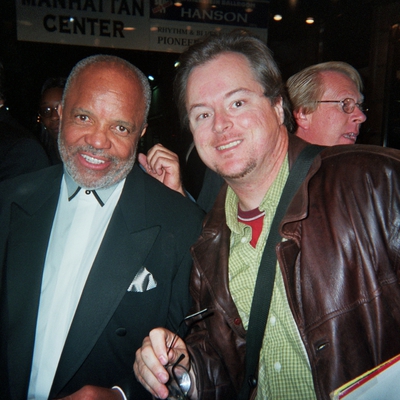
Berry Gordy
- Born Nov. 28, 1929
Berry Gordy III (also known as Berry Gordy Jr.) was born on November 28, 1929 in Detroit, to the middle-class family of Berry Gordy II (also known as Berry Gordy Sr.), who had relocated to Detroit from Oconee in Washington County, Georgia, in 1922. The first Berry Gordy was the son of a white plantation owner, James Gordy, in Georgia and his female slave. His half-brother, James, was the grandfather of President Jimmy Carter. Berry Gordy II was lured to Detroit by the job opportunities for black people offered by the booming automotive businesses.\n', 'Gordy Jr. developed his interest in music by writing songs and opening the 3-D Record Mart, a record store featuring jazz music and 3-D glasses. The store was unsuccessful, and Gordy sought work at the Lincoln-Mercury plant, but his family connections put him in touch with Al Green (no relation to the singer Reverend Al Green), owner of the Flame Show Bar Talent Club, where he met the singer Jackie Wilson.[citation needed]\n', '
In 1957 Wilson recorded "Reet Petite", a song Gordy had co-written with his sister Gwen and writer-producer Billy Davis. It became a modest hit, but had more success internationally, especially in the UK, where it reached the Top 10 and even later topped the chart on re-issue in 1986. Wilson recorded six more songs co-written by Gordy over the next two years, including "Lonely Teardrops", which topped the R&B charts and got to number 7 in the pop chart. Berry and Gwen Gordy also wrote "All I Could Do Was Cry" for Etta James at Chess Records.[citation needed]\n', '
Gordy reinvested the profits from his songwriting success into producing. In 1957, he discovered the Miracles (originally known as the Matadors) and began building a portfolio of successful artists. In 1959, with the encouragement of Miracles leader Smokey Robinson, Gordy borrowed $800 from his family to create an R&B record company. Originally, Gordy wanted to name the new label Tammy Records, after the song recorded by Debbie Reynolds. However, that name was taken, and he chose the name Tamla Records. The company began operating on January 21, 1959. "Come to Me" by Marv Johnson was issued as Tamla 101. United Artists Records picked up "Come to Me" for national distribution, as well as Johnson\'s more successful follow-up records such as "You Got What It Takes", co-produced by Gordy, who also received a co-writer credit, though the song was originally written and recorded by guitarist Bobby Parker for Vee Jay records a year and a half earlier. Gordy\'s next release was the only 45 ever issued on his Rayber label, featuring Wade Jones with an unnamed female backup group. The record did not sell well and is now one of the rarest issues from the Motown stable. Berry\'s third release was "Bad Girl" by the Miracles, the first release on the Motown record label. "Bad Girl" was a solid hit in 1959 after Chess Records picked it up. Barrett Strong\'s "Money (That\'s What I Want)" initially appeared on Tamla and then charted on Gordy\'s sister\'s label, Anna Records, in February 1960. It was The Miracles who gave the label its first million-selling hit single, with the 1960 Grammy Hall of Fame smash, "Shop Around" and this song, and its follow up hits,"You\'ve Really Got a Hold on Me" (another Grammy Hall of Fame-inducted hit), "Mickey\'s Monkey","What\'s So Good About Goodbye", and "I\'ll Try Something New", made The Miracles the label\'s first stars.\n', '
Return to Berry Gordy Autograph Profile
Stats
Join the RACC Facebook Group!
The Real Autograph Collectors Club (RACC) on Facebook is the largest community of in person autograph collectors and fans in the world, with 25,000 members and growing!

When you click on links to various merchants on this site and make a purchase, this can result in this site earning a commission. Affiliate programs and affiliations include, but are not limited to, the eBay Partner Network.
Useful Links
WORLDWIDE RACC (Our Top Cities)
New York, NY
USA
Los Angeles, CA
USA
London
United Kingdom
Chicago, IL
USA
Toronto, ON
Canada
